EVA Solar Encapsulation Film Market Trends: How Solar Growth Drives New Opportunities for Material Suppliers
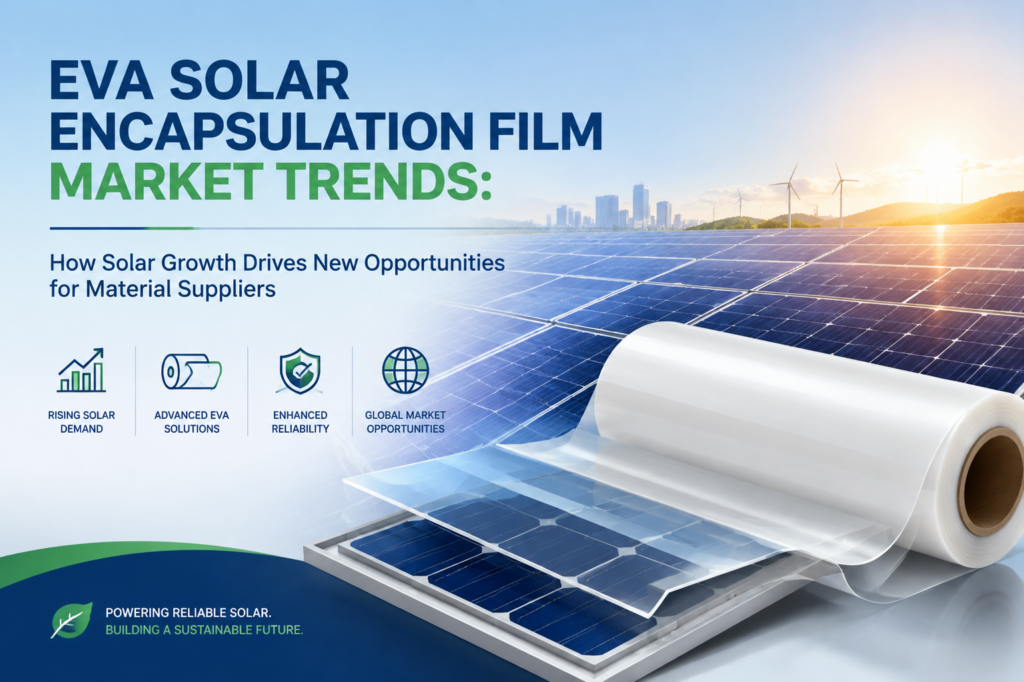
The global solar industry is entering a new phase of accelerated growth. Driven by renewable energy targets, energy security concerns, declining photovoltaic (PV) costs, and increasing investments in clean energy infrastructure, solar installations continue to expand across residential, commercial, and utility-scale markets.
While solar cells and modules often receive the most attention, the long-term performance of photovoltaic modules depends heavily on another critical component: encapsulation materials. As the protective layer that bonds solar cells with glass and backsheets, encapsulation film plays a vital role in module durability, reliability, and energy output.
Among various encapsulation technologies, EVA solar encapsulation film remains the most widely adopted solution due to its mature manufacturing process, excellent optical properties, strong adhesion, and proven reliability over decades of field applications.
The continued growth of the PV market is creating significant opportunities for EVA solar film manufacturers and advanced material suppliers to support the next generation of high-performance solar modules.
1. Global PV Growth Expands the EVA Encapsulation Film Market
The rapid expansion of solar energy capacity worldwide is directly increasing demand for PV encapsulation materials.
According to industry forecasts, global solar installations are expected to continue growing significantly over the next decade, driven by:
- Government renewable energy policies
- Increasing demand for clean electricity
- Large-scale solar farm development
- Distributed rooftop PV systems
- Industrial and commercial energy transition
Every gigawatt of new solar module production requires millions of square meters of encapsulation film. As module production capacity expands, the demand for reliable and scalable encapsulation materials continues to rise.
For material suppliers, this creates opportunities not only in supplying standard EVA films but also in developing specialized solutions for different solar technologies and application environments.
2. EVA Remains a Core Material Due to Its Engineering Advantages
Although new encapsulation materials such as POE and EPE are gaining attention, EVA continues to dominate the global market because it offers an exceptional balance between performance, cost, and manufacturing compatibility.
Key advantages of EVA solar encapsulation film include:
Excellent Optical Performance
High-transparency EVA films allow more sunlight to reach solar cells, helping maximize module power output. Advanced EVA formulations can achieve high light transmission while maintaining low haze.
Strong Adhesion
EVA provides reliable bonding between glass, solar cells, and backsheets, reducing risks such as delamination during long-term operation.
Mature Manufacturing Ecosystem
After more than 40 years of commercial application, EVA technology has developed a highly mature supply chain, including:
- Raw material availability
- Film extrusion technology
- Module lamination processes
- Quality testing standards
This maturity enables manufacturers to achieve stable production efficiency and competitive costs.
Proven Reliability
Millions of installed PV modules worldwide use EVA encapsulation films, providing extensive field data supporting their long-term durability.
3. Advanced Solar Technologies Create New EVA Innovation Opportunities
The evolution of photovoltaic technologies is creating higher requirements for encapsulation materials.
Traditional PERC modules previously represented a major portion of global production. However, emerging technologies such as:
- TOPCon
- HJT
- BC (Back Contact)
- Tandem Perovskite-Silicon Cells
are introducing new challenges for encapsulation suppliers.
Higher-efficiency solar cells require materials with improved:
- UV resistance
- PID resistance
- Thermal stability
- Moisture protection
- Long-term optical performance
As a result, EVA manufacturers are investing in advanced formulations to meet the requirements of next-generation modules.
For example, modified EVA films can provide enhanced resistance against ultraviolet degradation and improve module reliability in harsh environments such as deserts, coastal regions, and high-temperature areas.
4. Global Solar Manufacturing Expansion Creates Opportunities for Local Supply Networks
The solar industry is becoming increasingly globalized. While China remains the largest PV manufacturing hub, module production capacity is expanding in regions including Southeast Asia, Europe, North America, and the Middle East.
This geographic expansion creates new opportunities for PV encapsulation film manufacturers with global manufacturing and service capabilities.
Solar module manufacturers increasingly value suppliers that can provide:
- Stable international supply chains
- Local technical support
- Faster delivery
- Customized product solutions
A global production network allows material suppliers to reduce logistics risks and better support customers in different markets.
For EVA solar film manufacturers, building regional production and service capabilities is becoming an important competitive advantage.
5. Sustainability Trends Drive Innovation in Encapsulation Materials
As solar energy becomes a key solution for global decarbonization, the sustainability of PV supply chains is receiving increasing attention.
Material suppliers are responding by developing more environmentally friendly encapsulation solutions, including:
- Lower-carbon manufacturing processes
- Improved material efficiency
- Longer module lifetimes
- Better recyclability
Extending module lifespan is especially important because higher durability means more renewable electricity generation over the product lifecycle.
Advanced EVA films contribute to sustainability by helping solar modules maintain performance for 25 years or longer.
Conclusion
The rapid expansion of global solar energy is creating unprecedented opportunities across the PV supply chain. While solar cells continue to improve in efficiency, reliable encapsulation materials remain essential for converting technological innovation into long-term field performance.
EVA solar encapsulation film, with its proven reliability, cost advantage, and manufacturing maturity, will continue to play a critical role in photovoltaic module development.